
Traveling exhibition at historic monuments:
· at the Alyscamps: October–November–December 2026
· at the Cloître Saint-Trophime: January–February 2027
· at the Ancient Theater: March–April 2027
· at the Amphitheater: May–June 2027
· at the Baths of Constantine: July–August–September 2027
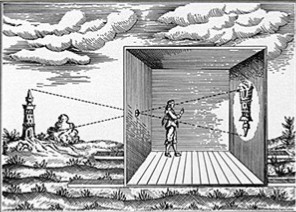
The “Camera Obscura,” a term derived from Latin meaning “dark chamber,” is the precursor to the modern camera.
It consists of a black box with a hole in one wall, which projects an inverted image of the outdoor scene onto the opposite wall.
Already known in antiquity during the time of Aristotle, around 300 B.C., this principle was described in the 10th century by the Arab scholar Ibn al-Haytham. In the 15th century, Leonardo da Vinci explained the phenomenon rationally. Then, during the 16th and 17th centuries, the idea arose to replace the small hole with a lens to improve the image quality, then to install a mirror to correct the orientation, and to use the camera obscura as a drawing tool.
Opening hours for each monument:
· October, March, and April: 9:00 a.m.–6:00 p.m.
· November, December, January, and February: 10:30 a.m.–4:30 p.m.
· May, June, July, August, September: 9:00 a.m.–7:00 p.m.
Last admission 30 minutes before closing.