
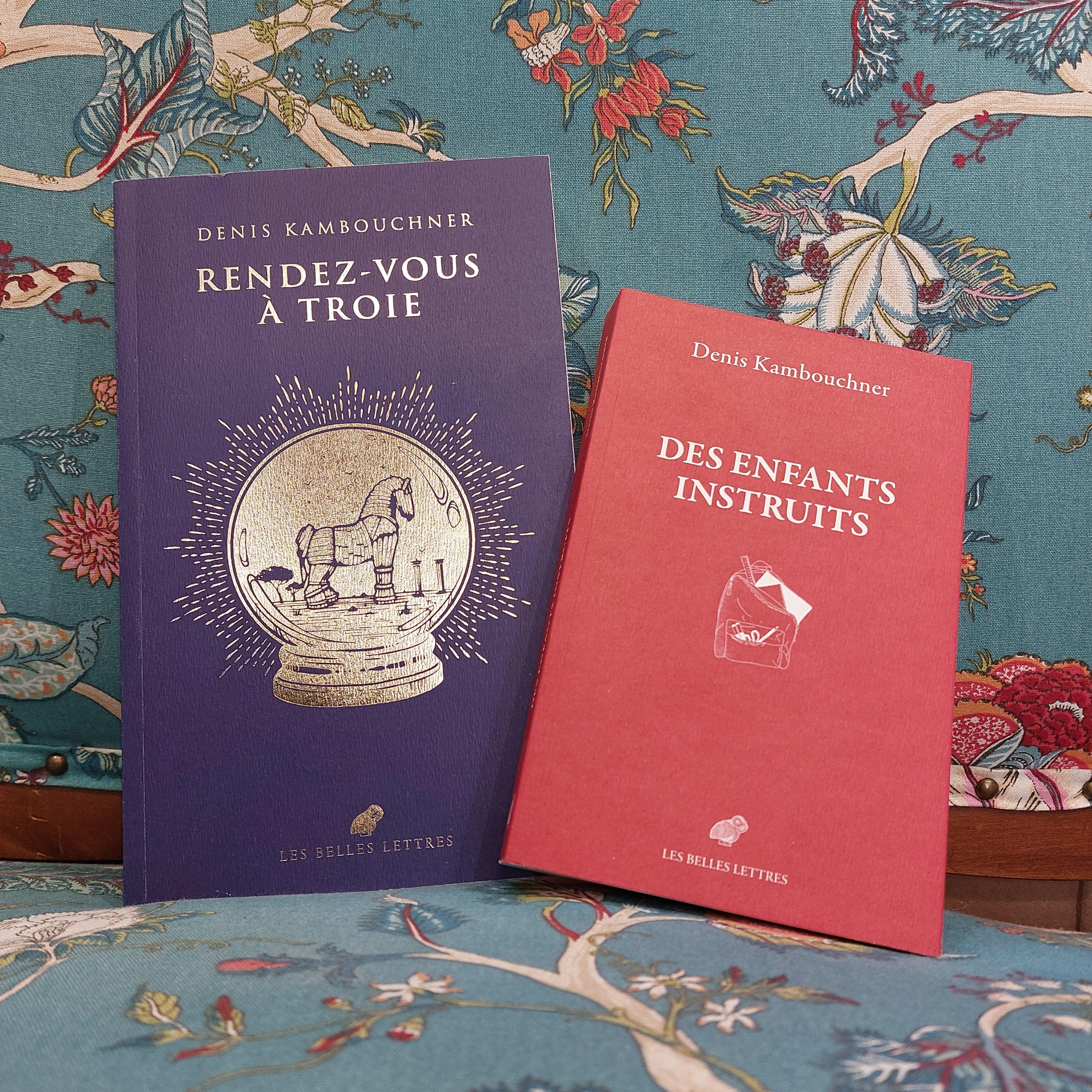
Denis Kambouchner, Professor Emeritus at Université Paris 1 Panthéon-Sorbonne, is a historian of modern philosophy. Director of the new edition of Œuvres de Descartes (Gallimard), he has notably published Descartes n’a pas dit (Les Belles Lettres, 2015). After Une école contre l’autre (2000), L’École, question philosophique (2013) and Quelque chose dans la tête (2019), Des Enfants instruits is his fourth book on the problems of school education and culture. He is also the author of a novel for young people, Rendez-vous à Troie (2nd ed., Les Belles Lettres, 2025).
Rendez-vous à Troie
Les Belles Lettres, March 2025
Through the spell of a crystal ball forgotten in a suburban attic, 13-year-old Léo Cerzanne finds himself on the shores of the Aegean Sea, at the siege of Troy.
Warmly welcomed by the heroes, Achilles and Patroclus, he learns that he is invulnerable and can turn invisible at will. Armed with all his courage, he ventures into the Greek camp, to the warriors’ assembly, then into the heart of the battle.
Achilles soon entrusts the young “traveler” with a mission that he is sure to fulfill. But will Leo be able to break the chain of events leading to Patroclus’ death? The gods are watching, and passions are terrible… Under the walls of Troy, he will at least have a rendezvous with friendship, before another adventure: that of his return.
The substance of the Iliad is made accessible to young readers, while respecting the richness of the plot and the poetry of the language. Léo’s experience takes place in the interstices of the epic: it is, in essence, that of the reader, with all that it implies in terms of commitment and astonishment. In this way, Rendez-vous à Troie, a formative novel for today, is also a rendezvous with great books.
Educated children. Reconciling school and culture
Les Belles Lettres, January 2026
Do you want educated children, or ignorant ones? Too blunt a question? It’s been said that what’s important, rather than knowledge, is the ability to find information. But no: for almost anything, you need a foundation, and to learn is to incorporate. That’s the first purpose of this book. Generally speaking, can our school produce educated children? Given its slope, we doubt it. The state of public service leaves too much to be desired. So what can be done? That’s the second aim of this book: to find ways of enriching schools, and fast.
The crisis in our education system is multi-faceted, both in its aspects and in its causes. The urgent task is not to find out who’s to blame, but to get to the root of the problems. The nature and value of the culture to be taught, the role and status of teachers, the place of screens and AI, relations with families, the fate of the republican ideal… In ten chapters, this book, which is aimed at everyone, sets out to shed light on a series of key points, and to define the new balances which, whatever the state of the world, school education will need.