
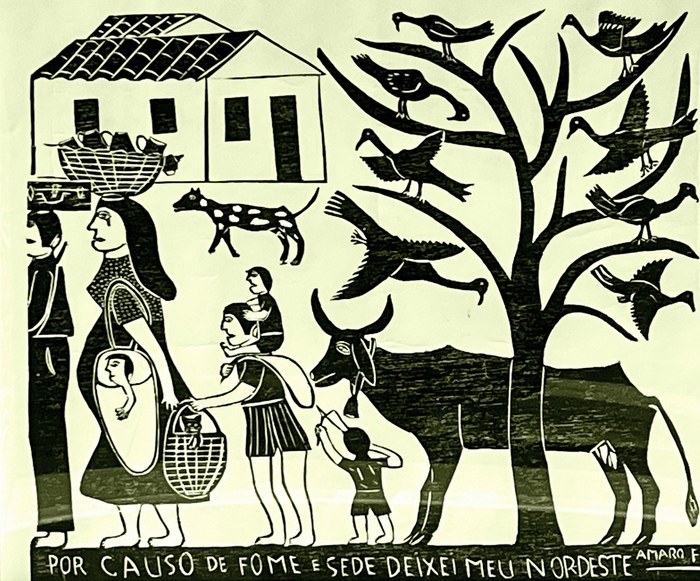
Morte e Vida Severina
is a collection of regionalist and modernist poems published in 1955. The work recounts the sufferings, through a difficult poetic journey, of Severino, a migrant from the countryside (“retirante”) in search of a better life in Recife, the capital of Pernambuco.
The poem is narrative, predominantly lyrical, but imbued with drama. It is divided into two parts: before arriving in Recife, the story is about the journey, the flight from death. Afterwards, it’s about the crib and the encounter with life.
“Because of hunger and thirst, I left my Nordeste”.
João Cabral de Melo Neto
(1920-1999) was a Brazilian poet and diplomat. His poetic work, oscillating between surrealism and popular poetry, is of great aesthetic rigor, composed of poems refractory to confessionalism and marked by the use of assonant rhyme. It inaugurated a new approach to Brazilian poetry. He is considered Brazil’s greatest contemporary poet.
Danielle Schramm
Danielle Schramm was born and raised in the state of Pernambuco, Brazil. After a spell at the Lycée Français in Madrid, she returned to France to complete a bachelor’s and master’s degree in Portuguese language and literature. After working for a time as an editor for various magazines, she went on to translate novels and texts by leading Portuguese, Brazilian and Angolan authors, in particular for Éditions Métailié.
Élisa Schramm
obtained her Diplôme d’Études Théâtrales and immediately wrote and directed her first show, Cymbalta, which ran for two years, followed by Dernier Chagrin, a superb one-woman show inspired by her relationship with her autistic, non-verbal younger brother, performed in Nice and Paris. She is currently writing her third text.
Cristiano Nascimento
born in Rio de Janeiro. This guitarist, composer and performer draws his musical universe from choro, samba, forró, candomblé and the sounds of Hermeto Pascoal.
A teacher at the IIMM in Aubagne
he regularly gives Masterclasses. His personal works are published by Productions d’Oz.