
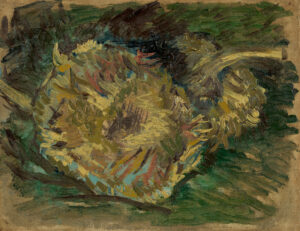
Vincent van Gogh, the eldest son of a clergyman, was born on March 30, 1853 in Groot Zundert. After working as a salesman in Paris and London for Goupil & Cie, then as a lay preacher in Belgium, he finally embraced a career as an artist: with the financial support of his brother Theo, he moved to Brussels in 1880 to study drawing at the Royal Academy of Fine Arts. Van Gogh then spent several months at the rectory in Nuenen, then in Antwerp, before joining his brother in Paris in February 1886. Introduced to Parisian painting circles, he discovered Impressionism and Japanese prints.
His desire for light and new landscapes led him to settle in Arles in February 1888. The landscapes overwhelmed him, and the southern sun revolutionized his use of color, which he saw as the key to modernity.
Van Gogh also expressed the wish to create a community of artists in the South, and rented a house for this purpose; only Paul Gauguin joined him for a few weeks, from October to December 1888.
On December 24, following a violent argument with his friend, Van Gogh mutilated his ear. Initially treated at the Arles hospital, he was admitted to the Saint-Paul-de-Mausole hospital in Saint-Rémy-de-Provence, where he was able to continue painting.
On May 16, 1890, he joined Theo in Paris, then moved to Auvers-sur-Oise. On July 29, he was shot and died of his wounds.