
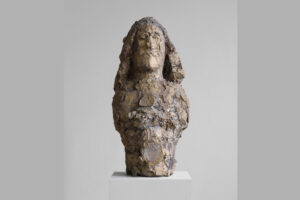
Hans Josephsohn, who died in Zurich (Switzerland) in 2012, was born in 1920 into a Jewish family in East Prussia, in Königsberg (today Kaliningrad in Russia). Having moved to Italy to complete his apprenticeship as a sculptor, he was forced to leave the country in 1938 in the face of the rise of Fascism, and found refuge in Zurich. Five years later, he received the last postcard from his parents, victims of the Holocaust.
He then opened his first studio, where he began to create rond-bosses and bas-reliefs in plaster, bronze and brass. His sculptures often feature female bust figures, lying or standing, with almost abstract features. Their intensity derives not from resemblance, but from the sensation of presence they produce, the psychic and physical effect of a “here and now”. Inspired by the history of sculpture, influenced by Egyptian statuary, Romanesque art and Impressionist painting, Josephsohn’s style is powerful and carnal; the fingerprints visible on the surface of his works are reminiscent of Van Gogh’s strokes pressed against the canvas. Josephsohn’s technique often involves assembling plasterboard around a void, then applying several layers of liquid plaster on top, which he then works by hand or with tools. In this way, he gives birth to hieratic entities with an ancestral appearance, which he can then cast while retaining the imprints of the modeling, as in the case of the three
brass busts featured in the exhibition.
Fondation Vincent van Gogh Arles
35ter Rue Dr Fanton
13200 Arles
Languages spoken
-
French

Go by bike
Average travel time from:
- Arles (downtown)2 min
- Saintes-Maries-de-la-Mer1 h 54 min
- Port-Saint-Louis2 h 4 min
- Les Salins-de-Giraud3 h 24 min