
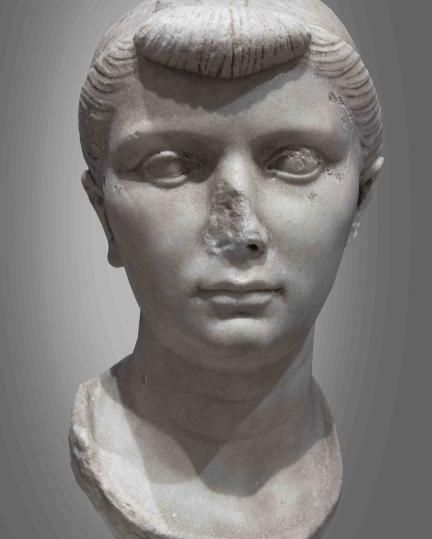
Born in the fall of 39 BCE, Julia was the only child of Emperor Augustus, who at the time was merely Caesar’s heir under the name Octavian. He was determined to marry her off in order to found a dynasty that would secure his succession. As a little girl, she grew up on the Palatine Hill alongside other children, under the supervision of Livia and Octavia; as a young woman, she was adored, married her cousin Marcellus at age 14, became a widow at 16, and remarried at 18 to Agrippa, a man her father’s age, mother—among others—of Agrippina the Elder, sent into exile at age 37, where she remained until her death in 14, shortly after her father’s death. According to the tradition of ancient authors, Julia remains a depraved woman “tainted by all manner of disgrace” (Suetonius).
However, Julia’s fate is indeed linked to that of the Julio-Claudian dynasty—all the way to its last ruler, Nero—through her lineage. She rubbed shoulders with the great figures of her time, starting with the poets Virgil, Ovid, Horace… and the patron of the arts, Maecenas. While there are not many depictions of her, we can discover her through a few portraits that have survived, through monuments, or in her private life by exploring the frescoes of her house on the Tiber in the rooms of the Palazzo Romano in Rome. Was Julie an emancipated young woman? Or, as Catherine Salles so aptly put it, a “princess who was too free”?
By Christine Chollet, professor of classical literature
A lecture as part of the Jeudis d’Arelate series
Musée départemental Arles antique
Avenue Jean Monnet
Presqu'Ile du Cirque Romain
13200 Arles
Languages spoken
-
French


Go by bike
Average travel time from:
- Arles (downtown)
- Saintes-Maries-de-la-Mer
- Port-Saint-Louis
- Les Salins-de-Giraud